
 Promoting Diversity
 SEIBU
SEIBU Dealing with Natural Capital
The Seibu Group, in accordance with the Group Vision, which is its management philosophy, emphasizes consideration for the natural and global environment, and is actively involved in environmental conservation through its business activities. In addition to climate change, we also recognize the seriousness of nature-related risks, and we are taking measures to address these risks while promoting initiatives to take advantage of related opportunities.
Seibu Holdings endorsed the disclosure recommendations published in September 2023 by TNFD (Taskforce on Nature-related Financial Disclosures) and registered as a TNFD Adopter that adopts the recommendations. We also participate in the TNFD Forum.
Toward achieving the Kunming-Montreal Global Biodiversity Framework’s 2050 Vision, "a world living in harmony with nature," the Seibu Group formulated the Seibu Group’s Nature Positive Declaration in March 2024, and participates in the 30 by 30 Alliance for Biodiversity. Initiatives to conserve biodiversity and maintain natural capital include preserving our group-owned forests and satoyama woodland, rescuing injured wildlife, and improving the natural environment around real estate facilities.
In accordance with the framework recommended by TNFD, we have identified the Group’s business dependence on and impact on nature and analyzed and assessed the risks and opportunities in our operations. As a result, we have found a certain degree of dependency and impact, as well as some risks, throughout the supply chains in our Group’s operations, while also identifying significant opportunities. Based on our analysis, we have recognized that while it is of course important to take steps to reduce risk, it is also important for the Group to contribute to natural capital while capturing nature-related business opportunities in particular.
We will keep promoting these initiatives, and continue our efforts to identify nature-related risks and opportunities and disclose information in compliance with TNFD recommendations.
Governance
We established the Seibu Group Sustainability Actions Development Guidelines and a system to promote our sustainability actions, which are efforts to realize a sustainable society, in a continuous, proactive, and systematic manner. The Seibu Group Sustainability Committee is chaired by the CEO and composed of the president, the executive officer for the Corporate Strategy Department, which is the main department in charge of promoting sustainability actions and formulating Group management plans, the executive officer for the Human Capital Strategy Department, and the presidents of the Group’s major operating companies. The committee analyzes and assesses the risks and opportunities linked to climate change and nature, discusses how to appropriately manage risks and turn opportunities into commercial success, and monitors and determines the direction of nature-related initiatives.
TNFD has also emphasized engagement with indigenous peoples and local communities in relation to nature. The Group Vision, which is the Seibu Group’s management philosophy, states that we will contribute to the development of local communities, while the Seibu Group Code of Corporate Ethics, which serves as the basic rules of the Group, stipulates that we will build relationships with a wide range of stakeholders. We also conduct human rights due diligence in accordance with the Seibu Group Human Rights Policy, which stipulates respect for the human rights of all persons involved in our business activities; the Seibu Group Sustainable Procurement Policy, which stipulates respect for human rights in our procurement activities and consideration for the environment; and the Seibu Group Supplier Guidelines, and report on how we are progressing with this at this committee.
The content of the discussions at this committee are reported to the Board of Directors.
Strategy
We have been conducting assessments of nature-related risks and opportunities in line with the LEAP approach recommended by TNFD. This time, we have assessed the Real Estate business and the Hotel and Leisure business*, both of which have a strong relationship with nature.
* A simple assessment using ENCORE of the dependence and impact of the Urban Transportation and Regional business showed a relatively weak relationship with nature compared to the Real Estate business and the Hotel and Leisure business.
STEP 1: Discover points of contact with nature (Locate)
We identified the location information of sites owned and operated by the Group and where its sales activities are conducted, and assessed the natural conditions of the surrounding areas.
STEP 2: Diagnose dependence and impact (Evaluate)
We identified and assessed the degree of significant dependence and impact on nature in the Group’s operations to be assessed.
STEP 3: Assess risks and opportunities (Assess)
We summarized the nature-related risks and opportunities in the Group’s operations to be assessed.
STEP 4: Prepare measures and reporting (Prepare)
We prepared for appropriate information disclosure by organizing measures to manage the assessed risks and to turn opportunities into commercial success.
Assessment of Dependence and Impact
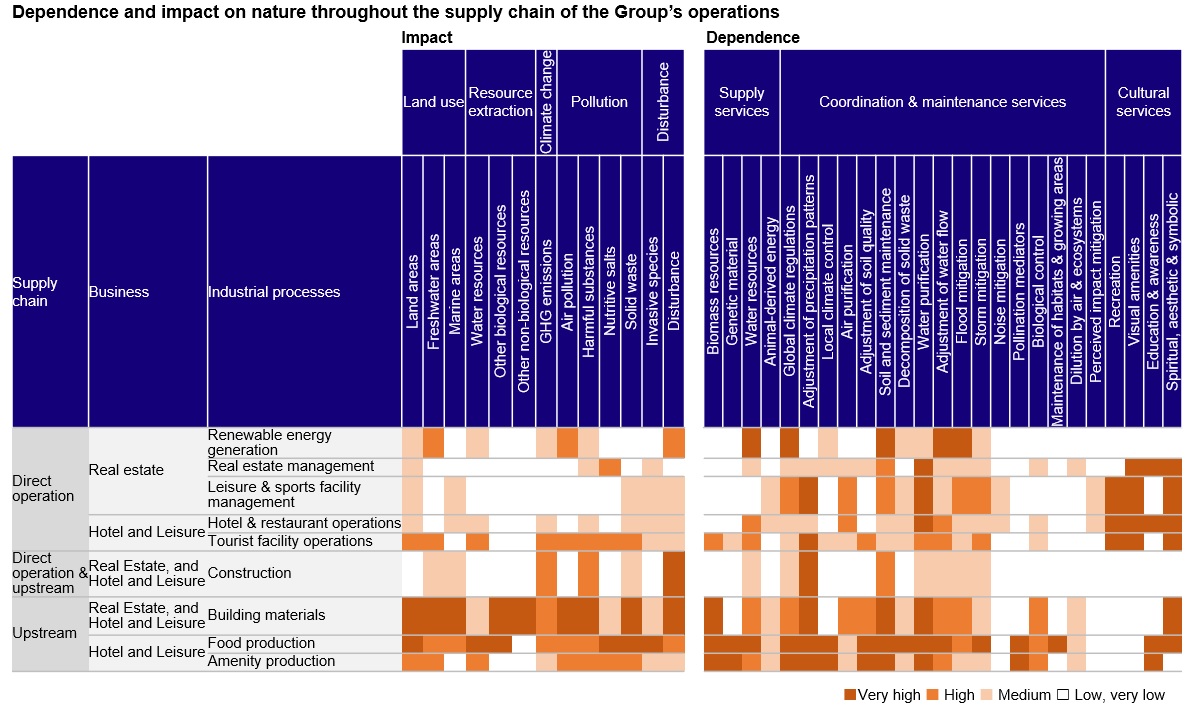
We identified and assessed the degree of significant dependence and impact on nature in the Group’s operations to be assessed. We conducted the assessment with reference to ENCORE, a tool recommended by TNFD, and in-house information, and summarized the results in a heat map.
Direct operations were found to be heavily dependent on cultural services. Many office buildings and commercial facilities managed or operated by the Group have green spaces on or around their premises. At these sites, the abundant greenery is expected to increase user visits and enhance the attractiveness of the area, which depends on nature’s ability to provide amenities and places for people to interact. In addition, many guests stay at facilities managed and operated by us for the purpose of observing and experiencing the surrounding seasonal nature and forest bathing, indicating a dependence on nature as a tourism resource.
Upstream, we have reaffirmed that the procurement of building materials for the construction of office buildings and commercial facilities, as well as foodstuffs for hotels, involves a high degree of dependence and impact on nature. In 2022, we formulated the Seibu Group’s Sustainable Procurement Policy and Seibu Group Supplier Guidelines in order to encourage the Group and its business partners to consider ecological issues in their business activities. We are also implementing resource recycling initiatives and other measures to understand and address the dependence and impact on nature throughout the supply chain.
Assessment of Risks and Opportunities
Based on the dependence and impact assessment results and the characteristics of the Group’s business, we have summarized the nature-related risks and opportunities in the Group’s operations to be assessed.
Nature-related risks included physical risks such as reduced property value due to degradation of the surrounding ecosystem, and transition risks such as stricter land use regulations related to nature conservation and disengagement from stakeholders due to changes in nature-related values. Upstream in the supply chain, procurement risks for building materials and foodstuffs were also mentioned.
On the other hand, a number of nature-related opportunities were identified, including business opportunities for the Group and initiatives that will have a positive impact on the region. These included environmentally friendly real estate with green spaces, acquiring new needs through eco-tourism and hotel operations in harmony with nature, and building relationships with local stakeholders by protecting ecosystems. To maximize these opportunities, Seibu Landscape Co., Ltd. ’s greening technology and the use of land and our group-owned forests in some of Japan’s leading tourist destinations were also considered important. Also mentioned were opportunities for Seibu Landscape Co., Ltd. ’s technology and expertise to increase sales through designs that take into account biodiversity and natural capital, which are expected to be in even greater demand in the future.
For details on Nature-related risks and opportunities in the Group's direct operations and upstream supply chain, please click here.
Assessment of Priority Areas
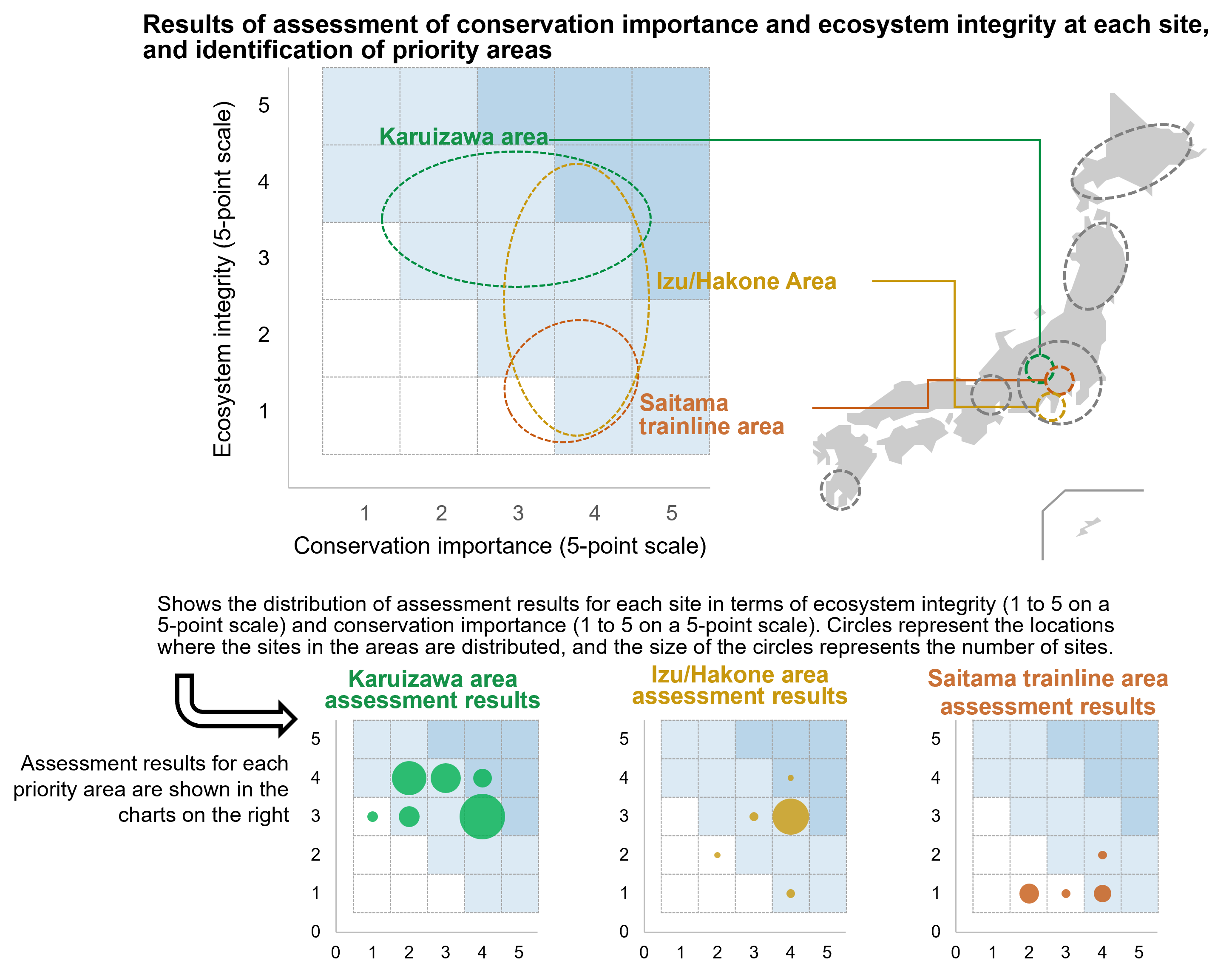
We considered domestic sites owned and operated by the Group and where its sales activities are conducted, and assessed the natural conditions of the surrounding areas. Assessment work was conducted at each site using data* obtained by external tools etc. according to five criteria defined by TNFD (conservation importance, ecosystem integrity, rapid degradation of ecosystem integrity, physical water risk, importance of ecosystem services).
* Assessment according to the five criteria was done using the following data and tools.
❑Conservation Importance ... Assessed by using IBAT to identify proximity to areas of high conservation importance (protected areas and key biodiversity areas) and STAR (Species Threat Abatement and Restoration Metric) values.
❑Ecosystem integrity ... Assessed by using the Biodiversity Intactness Index provided by the Natural History Museum.
❑Rapid degradation of ecosystem integrity ... Assessed by identifying Pressures on Biodiversity, an indicator of the magnitude of the impact on nature provided by the WWF Biodiversity Risk Filter.
❑Water related physical risk ... Assessed by using Aqueduct to identify baseline water stress and flood risk (rivers and coasts).
❑Importance of ecosystem services ... Assessed by using Global Forest Watch to identify proximity to areas managed by IPLCs (Indigenous Peoples and Local Communities).
Looking at the trends in the assessment results, it was found that out of the TNFD’s five criteria, some areas had higher conservation importance and ecosystem integrity than others. There were no sites with particularly high water risk or rapid degradation of ecosystem integrity. Conservation importance and ecosystem integrity tended to be higher at sites in resort areas, especially those around Karuizawa and Izu/Hakone. Suburban real estate properties tended to have relatively low ecosystem integrity, while conservation importance was slightly higher at sites along the Seibu Railway line in Saitama Prefecture (referred to below as Saitama trainline area). Based on the above, the Karuizawa area, Izu/Hakone area, and Saitama trainline area were designated as three priority areas.
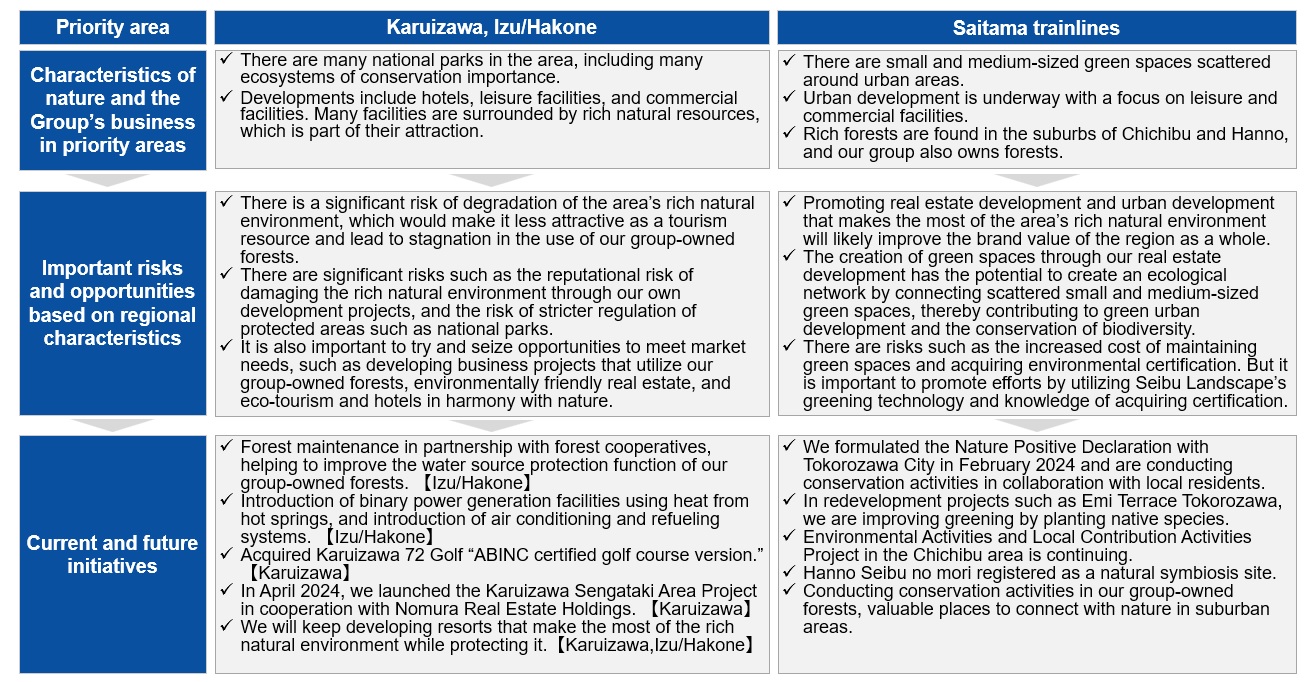
Priority area characteristics, major risks and opportunities, and future initiatives
The table below shows the results of an in-depth analysis of risks, opportunities and future initiatives in the three priority areas.
Risk and Impact Management
Sustainability-related risks, such as nature and climate change, are identified by the Seibu Group Sustainability Committee. Risks and opportunities that have been analyzed and assessed are properly handled by sustainability actions in the Sustainability Action Promotion System and risk management in the Risk Management System. Sustainability-related risks, such as nature and climate change, are designated as particularly important risks in the Risk Management Plan formulated annually in accordance with the Seibu Group Risk Management Regulations, and are integrated into and managed as part of companywide risk management.
Indicators and targets
We monitor our environmental performance and set targets for some indicators. The current TNFD global core disclosure indicators are as follows.
| Monitoring status | Target setting status | Relationship with TNFD disclosure indicators |
|---|---|---|
| Monitoring and disclosing the ratio of our group-owned land converted for environmental conservation | 30% of total company-owned land by fiscal year ended March 31, 2031※1 | Global core disclosure indicators C1.1 |
| Monitoring and disclosure of industrial waste emissions and food waste volume | Decrease from the previous fiscal year in each basic unit※2 | Global core disclosure indicators C2.2 |
| Monitoring and disclosure of purchase products using specified plastics | 50% reduction in each basic unit from fiscal year ended March 31, 2019 level by fiscal year ended March 31, 2031※1 | Global core disclosure indicators C2.3 |
※1 The scope of application is Seibu Realty Solutions.
※2 The scope of application is Seibu Holdings Inc. and the group's all units for per-unit industrial waste emissions (emissions/operating revenue), and the scope of application is Seibu Realty Solutions and Seibu Prince Hotels Worldwide for the basic unit of food waste (amount of waste/number of guests).
| Monitoring status | Relationship with TNFD disclosure indicators |
|---|---|
| Monitoring and disclosure of water discharge volumes※1 and water pollutant emissions※2 | Global core disclosure indicators C2.1 |
| Monitoring and disclosure of emissions of substances that impact the atmosphere※3 | Global core disclosure indicators C2.4 |
| Formulating and implementing policy using local species in redevelopment projects., etc. | Global core disclosure indicators C4.0 |
※1 The scope of application is Seibu Holdings Inc. and the group's all units, and for group units that do not individually measure the amount of water discharge, the amount of water withdrawal was applied.
※2 Chemical Oxygen Demand (COD) emissions are disclosed in accordance with various laws and regulations.
※3 NOx emissions, particulate emissions, Sox emissions, Voc emissions, and Particulate Matter (PM) emissions are disclosed in accordance with various laws and regulations.